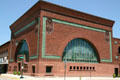
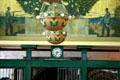
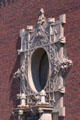
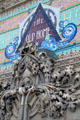
Louis Henri Sullivan, an Architectural Chronology & Legacy in Photos

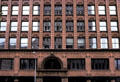
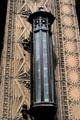
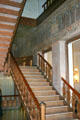
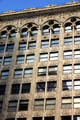
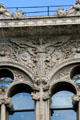
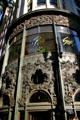
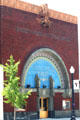
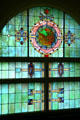
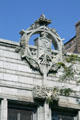
Louis Henri Sullivan was one of the most innovative American architects. His buildings are often distinguished by their decoration in what can be described as a combination Art Nouveau and Celtic scrollwork. He is was an early mentor of Frank Lloyd Wright. Original images by Jim Steinhart trace Louis Henri Sullivan's artistry & legacy.

Click here for Sullivan photos on this page in an enlargeable format. Subject index for Architects
  • September 4, 1856: Louis Henri Sullivan born in Boston.
  • 1872: Studied architecture at Massachusetts Institute of Technology.
  • 1873: Moved to Philadelphia to work for architect Frank Furness, designer of Pennsylvania Academy of Fine Arts.
  • 1873: Laid off by Furness due to depression of 1873.
  • 1873: Moved to Chicago & worked for architect William LeBaron Jenney.
  • 1874: Moved to Paris to study at the École des Beaux-Arts.
  • Traveled to Rome & finds revelation in Michelangelo's Sistine ceiling.
  • 1875: After 6 mos in Europe, returned to Chicago to work for Joseph S. Johnston & John Edelman as a draftsman.
  • 1875: Became fascinated with new architecture based on iron construction through friendship with engineer Frederick Baumann.
  • Obtained commissions to decorate Edelmann's Sinai Synagogue & then Moody Tabernacle.
  • 1879: Employed by architect Dankmar Adler.
  • 1880: Becomes partner in Adler & Sullivan.
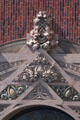
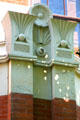
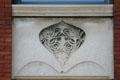
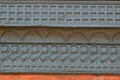
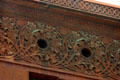
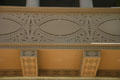
  • Sullivan Art


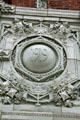
    Sullivan Art


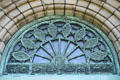
    Sullivan Art
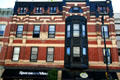
  • 1883: Kauffmann Store & Flats, Chicago by Adler & Sullivan
  • Kauffmann Store
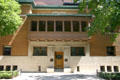
  • 1884: Leon Mannheimer Home, Chicago by Adler & Sullivan
  • Mannheimer Home
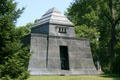
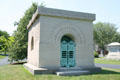
  • 1887: Martin Ryerson Tomb in Graceland Cemetary, Chicago by Adler & Sullivan
  • Ryerson Tomb
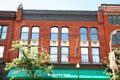
  • c1889s: Desenberg Block, Kalamazoo, MI.
  • Desenberg Block
    Desenberg Block
    Desenberg Block
  • 1880s: Adler & Sullivan make mark designing theaters.

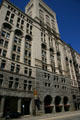
  • 1889: Auditorium Building (now Roosevelt University), Chicago introduces concept of mixed use theater, hotel & office building.
  • Auditorium Building
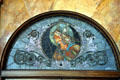
    Auditorium window
  • 1890s: Adler & Sullivan shift to designing office buildings.

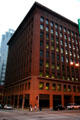
  • 1891: Wainwright Building, St. Louis. They invent aesthetic treatment for highrise exterior.
  • Wainwright Building
    Wainwright Building
  • 1887: Frank Lloyd Wright joins Adler & Sullivan, works up to Sullivan's Chief Assistant.
  • 1891: James Charnley House by Sullivan & Wright, Chicago
  • 1893: Wright leaves Sullivan for unclear reasons, perhaps about Wright's poaching Sullivan's clients.
  • Charnley House
    Charnley House
    Adler & Sullivan 1890s commissions.
  • 1890: Carrie Eliza Getty Tomb in Graceland Cemetary, Chicago
  • 1891: Kehilath Anshe Ma'ariv Synagogue, Chicago
  • 1892: Charlotte Dickson Wainwright Tomb, Bellefontaine Cemetery, St. Louis
  • 1894: Chicago Stock Exchange Building, Chicago
    (demolished though trading room & entryway arch now at Art Institute of Chicago)
  • Getty Tomb
    Getty Tomb Kehilath Anshe Ma'ariv Synagogue
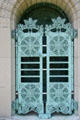
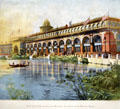
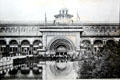
  • 1893: Sullivan designs Transportation Building for World's Columbian Exposition. It has arched Golden Door & multicolored facade which departed from overall White City concept of Beaux-Arts structures conceived by fair planner Daniel Hudson Burnham, leading to clashes between them. All but one of Exposition's buildings were destroyed by arsonists after the event.
  • 1893 Chicago World's Fair Transportation Hall 1893 World's Columbian Exposition Transportation Hall
  • 1895: Guaranty (former Prudential ) Building, Buffalo.
  • Guaranty Building
    Guaranty Building
    Guaranty Building
  • 1895: Adler & Sullivan dissolve partnership after drop in commissions resulting from financial Panic of 1893.
  • Since Adler was the partner who landed most commissions, Sullivan's career starts its decline.
  • 1898: Bayard-Condict Building, New York.
  • Condict Building
    Condict Building
  • 1899: Carson Pirie Scott Department Store, Chicago.
  • Carson Pirie Scott Store
    Carson Pirie Scott Store
    Sullivan exists on small commissions.
  • 1899: Gage Group (Ascher, Keith, & Gage) of Buildings, Chicago
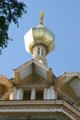
  • 1903: Holy Trinity Russian Orthodox Cathedral & Rectory, Chicago
  • 1907: Babson Residence, Riverside, IL
  • Holy Trinity Cathedral
    Sullivan lands a series of commissions for what he calls Jewel Box banks.
  • 1908: National Farmer's Bank, Owatonna, MN
  • 1912: Peoples Savings Bank, Cedar Rapids, IA
  • 1913: Henry C. Adams Building (Land & Loan Office), Algona, IA
  • 1914: Merchants' National Bank, Grinnell, IA
  • 1914: Home Building Association Company, Newark, OH
  • 1914: Purdue State Bank, West Lafayette, IN
  • 1918: People's Federal Savings & Loan Association, Sidney, OH
  • 1919: Farmer's & Merchant's Union Bank, Columbus, WI
  • Owatonna, MN Jewel Box Bank

    Cedar Rapids, IA Jewel Box Bank

    Grinnell, IA Jewel Box Bank

    Columbus, WI Jewel Box Bank
  • 1915: J.D. Van Allen Dry Goods Co. Store, Clinton, IA
  • Van Allen Store, Clinton, IA
  • 1922: William P. Krause Music Store, Chicago
  • Krause Music Store
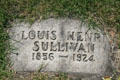
  • April 14, 1924: Sullivan's dies poor & alone, in a Chicago hotel room.
  • Sullivan buried under simple headstone in Graceland Cementery.
  • Architectural community later puts up memorial to Sullivan in Graceland Cementery.
  • Sullivan Gravestone
    Sullivan Monument

    All photos on this page are originals by & copyrighted by Jim Steinhart.
    All rights reserved. Permission required to use.